
Announcing DocCharm
At Supercede, our Zendesk help center kept falling behind the product. Every release changed some behaviour that was documented somewhere, and updating the articles was nobody’s job in particular, so it happened late or not at all.
So, I built DocCharm. It keeps a help center current automatically by watching pull requests as they land in your GitHub repository. When a change affects something your documentation describes, it suggests updates to the relevant articles — or drafts entirely new ones if nothing appropriate exists yet.
Drafts are not published on their own. Everything lands in a review queue first, where a human checks it and can edit before approving. The machine does the tedious part — noticing that the docs are stale and writing the first draft — and a person can just approve, or edit, or dismiss. In practice this has proven to be a pretty slick workflow!
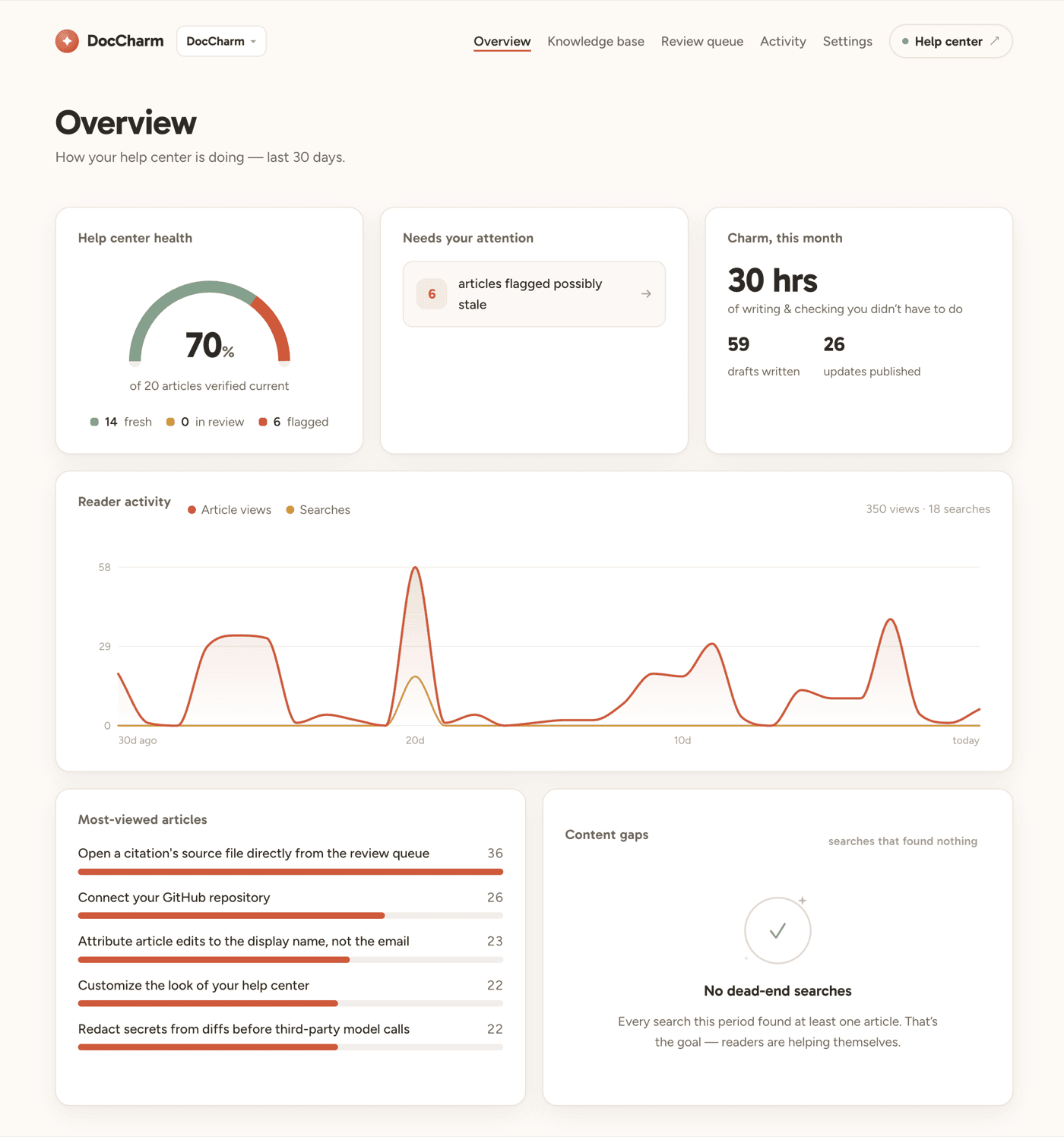
We’ve been using it at Supercede for a while now and it’s a big time saver. It’s also gaining some traction with other companies in the same investor portfolio. My sales process so far has been high-touch outbound. This probably won’t scale in the long run, but I’m hoping to learn as much as I can by nurturing all of the initial relationships.
To that end: if you run a business with a help center that’s drifting out of date, email me and I’ll comp your first couple of months.
Both Zendesk and Mintlify help centers can already be automatically imported into DocCharm. If you use a different help center, let me know and I’ll get it automatically imported one way or another.
The tech is essentially the same tools I use for everything:
- Haskell/Yesod
- NixOS
- SQLite with Litestream
- Sentry for error reporting
- Stripe for billing,
- Healthchecks.io as a dead man’s switch
- Prometheus and Grafana for telemetry
- Resend for transactional email